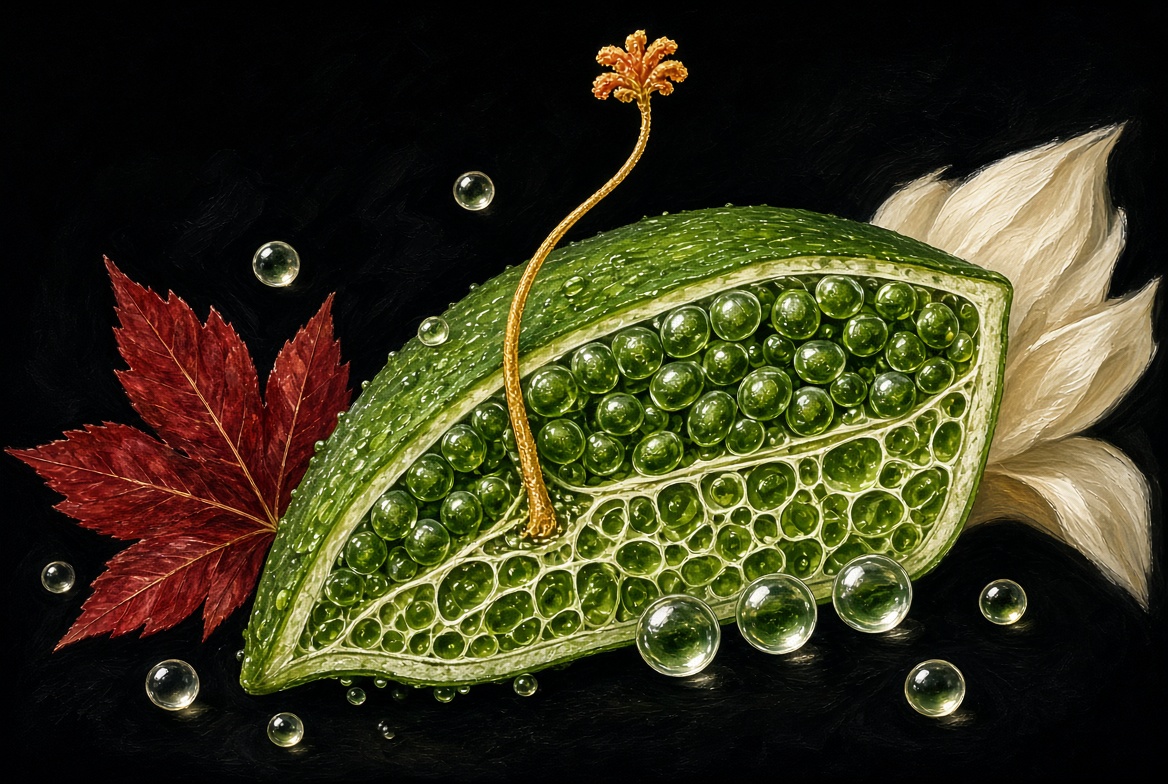
Four materials, four chemistries
Reviews count more than 100 annonaceous acetogenins in the plant, about 46 of them from the leaf, including annonacin and the annomuricins. Leaf flavonoids run rutin first, then quercetin and kaempferol. Alkaloids include reticuline and coreximine. Phenolics and megastigmanes sit underneath.
Roughly 90% of coconut oil is saturated triglyceride. Virgin oil is about half lauric acid. Lauric acid’s monoglyceride, monolaurin, is the piece studied against skin staphylococci in the dish. On skin the oil is also an occlusive fat.
The red is crocin. The smell is safranal. Crocetin is the aglycone. A 2023 skin paper used Super Negin threads meeting ISO 3632-2 and found, in fibroblasts, more collagen and hyaluronic acid, plus collagenase and tyrosinase inhibition in the tube.
Chlorophyll and its copper salt chlorophyllin are antioxidants in simple assays. Topical chlorophyllin has a small wound and odour literature. In this bottle it is also the colour: strain and tint, no threads left in the glass.
Cellular restoration, said in biology
A skin cell does not wait for a bottle. Keratinocytes turn over in roughly a month. Fibroblasts lay collagen. Barrier lipids — ceramides, cholesterol, free fatty acids — keep water in. “Regeneration” in a clinic means a wound closing, or a stem-cell niche doing its job. “Cellular restoration” on this label means the nearest honest version of that: feed the barrier a fat it recognises, put a leaf phenol and a saffron carotenoid where oxidative stress is ordinary, and repeat it.
What the studies actually show, at the strength they have:
- Coconut on skin. In young rats, topical virgin coconut oil shortened the time to full epithelial cover and raised collagen cross-linking and fibroblast number in the granulation tissue (Nevin and Rajamohan, 2010). In children with mild-to-moderate atopic dermatitis, a randomised trial of 117 found virgin coconut oil better than mineral oil on score, water loss, and capacitance over eight weeks. Dry-skin work finds it about as good as mineral oil. That is barrier care. It is not organ repair.
- Saffron on fibroblasts. Super Negin extract, in a dish, pushed human dermal fibroblasts to make more collagen and hyaluronic acid and to migrate across a scratch. Picrocrocin and crocetin moved cells more than safranal. This is a cosmetic-mechanism paper, not a trial of a 30 ml comfort oil.
- Dose, said plainly. Clinical saffron trials for mood or the retina typically use around 30 mg of extract a day. This bottle holds about 0.05 g of Super Negin threads in 30 ml. A teaspoon is about 5 ml, so the saffron in a daily spoon is a kitchen trace, not a trial dose. The gold is aroma, colour, and a carotenoid presence. It is not a saffron medicine hiding in oil.
- The leaf. Most of the dramatic Annona papers are acetogenins on cancer cell lines, or leaf extracts in diabetic rodents. Acetogenins inhibit mitochondrial complex I. That is why they look potent in a tumour dish. It is the same lever behind the neurotoxicity concern below. A dish result is not a human remission.
The acetogenin problem, not hidden
Annonacin blocks complex I of the mitochondrial respiratory chain. In Guadeloupe, neurologists tied heavy lifelong soursop fruit, and Annonaceae leaf tea, to an atypical parkinsonism. A 2022 Movement Disorders paper went further: in people who already had degenerative parkinsonism, even low cumulative fruit intake, or any herbal tea from the family, tracked with worse disease and worse cognition. No safe open-ended daily dose has been established.
Traditional Caribbean use was a kettle for a bad night or a fever, not a lifetime tonic. The house use is one teaspoon of an oil infusion, leaf not seed, food grade. Seed oil is a different and heavier annonacin material, and it is not in this bottle. Even so, the science page will not pretend the association is folklore. Skip the oil in pregnancy, in childhood, and if you or your family carry a parkinsonian or mitochondrial diagnosis. It does not replace a doctor.
The holistic frame, without the bad physics
Holistic here means the whole day, not a force the lab missed.
The island reading. Antigua’s bush list has soursop tea as a soporific, and the boiled leaf as a sweat for fever. Fever grass, aloe, and the midwife’s nine-day Christmas-bush bath sit beside it. The oil is that night leaf moved from the cup into coconut fat, so it can also go on hair and skin. Chef first, anointing second. Kasandrinos, if it is on the plate, stays a single-source Laconia olive oil and is never folded into this bottle.
The Sebi reading. Alfredo Bowman taught that mucus and acidity underlie disease, and that “electric” plants restore an alkaline terrain. As a ritual — plants daily, less ultra-processed food — it pushed a generation back to the hedge. As physiology it does not hold. Blood pH sits near 7.40 and is defended by lungs and kidneys; a meal does not alkalise it in any meaningful way. Stomach acid is supposed to be acid. SwissX keeps the ritual and drops the terrain theory. Inspired by him. Not his recipe. Not his cure claim. The New York civil bar on therapeutic claims is the line this label already obeys.
The cellular reading we will actually say. Oxidation is ordinary. A phenol, a carotenoid, and a lauric fat are ordinary answers to it — food answers. Skin that is occluded and fed fatty acids holds water better; water-holding skin looks restored. That is the powerful part that survives contact with the papers. Repeating it is the ancient part. Calling it a cure is the part that does not survive.
How the three days matter
A bain-marie is water around the pot, so the leaf never sits on a naked flame. Three days is a long infusion, not a boil-and-dump. Heat like that moves phenolics and some acetogenins into fat better than a cold soak, and it keeps the coconut from scorching. Saffron goes in after the cool: crocin and safranal are happier out of a hard boil. Strain. Tint with chlorophyll. The glass is oil. Nothing to chew. Nothing to inhale.
What we measured, and what we did not
Every SwissX Island product — the comfort oil, the packaged lines, and SoilBooster — is tested at SwissX Labs Zurich and at the Department of Analytical Services, Antigua and Barbuda. The footprint of those plants is measured against the full blockchain recording from seed to sale. This page does not invent a certificate the bottle does not have, and it does not put a carbon-credit dollar figure on the glass. There is no published clinical trial of this exact three-day blend on wound closure, collagen, or any disease. The science above is the science of the materials. The bottle is the house way of putting them together.